Best Hearing Supplements 2026: Top Picks, Compared Honestly
This article is for informational purposes only and is not medical advice. No supplement has been proven to treat, cure, or reverse hearing loss or tinnitus — the National Institute on Deafness and Other Communication Disorders (NIDCD) and the American Academy of Otolaryngology–Head and Neck Surgery both state this plainly. If you have sudden or one-sided hearing loss, tinnitus, or dizziness, see a doctor immediately — those can be signs of a medical emergency. Some links on this page are affiliate links, meaning we may earn a commission at no extra cost to you if you purchase through them. This does not influence our honest scoring.
Table of Contents
- Quick Verdict
- Comparison Table
- #1 Audifort Review
- #2 Quietum Plus
- #3 SonoVive
- #4 NeuroQuiet
- What Reddit & Quora Users Say
- The Clinical Evidence, Honestly
- Common Concerns & Skepticism
- FAQ
- Bottom Line
Best Hearing Supplements 2026: Top Picks, Compared Honestly
If you have searched for hearing support online, you already know the landscape: dozens of bottles promise sharper hearing, quieter tinnitus, and restored ear health — and almost none of them has a published clinical trial on the finished product to back those claims. The National Institute on Deafness and Other Communication Disorders (NIDCD) reports that roughly 15% of U.S. adults experience some form of tinnitus, and about 1 in 8 Americans aged 12 and older has measurable hearing loss in both ears. That is a huge number of people looking for answers, and the supplement industry has noticed.
Here is the honest framing for everything below: no dietary supplement reverses permanent sensorineural hearing loss. Once inner-ear hair cells die, they do not regrow in humans. What a well-chosen supplement may do is support remaining hair cells, improve blood flow to the inner ear, and fill nutrient gaps linked to auditory dysfunction. In this 2026 comparison we evaluated the four most popular hearing formulas — Audifort, Quietum Plus, SonoVive, and NeuroQuiet — by ingredient transparency, price, guarantee, evidence, and marketing honesty.
Last reviewed: October 2026 · Fact-checked against NIDCD, the American Tinnitus Association, the AAO-HNS clinical guideline, and peer-reviewed studies.
Quick Verdict
#1 Pick: Audifort — 4.1 / 5 (our honest score)
Best for: adults with mild age-related hearing changes or occasional tinnitus who want a comprehensive antioxidant + circulation + neural-calming formula, the longest guarantee in the niche, and liquid absorption.
Not for: anyone on blood thinners, people with blood-sugar conditions who are not monitoring glucose, anyone expecting a cure, and budget buyers — there is no single-bottle option and entry pricing is $158+.
Best Hearing Supplements 2026: Comparison Table
| Product | Format | Core Angle | Key Ingredients | Lowest Price / Bottle | Guarantee | Our Rating |
|---|---|---|---|---|---|---|
| Audifort (our #1) | Liquid drops, 60 mL | Antioxidant + circulation + neural calming | Maca, Grape Seed, Green Tea (EGCG), Capsicum, Gymnema, GABA (22-ingredient blend) | $49 (6-bottle tier) | 90-day (ClickBank) | ★ 4.1/5 |
| Quietum Plus | Capsules, 60ct | Ear-brain + adaptogenic | Mucuna, Maca, Ashwagandha, Dong Quai, Zinc, L-Tyrosine, L-Arginine, B vitamins | $49 | 60-day | ★ 3.9/5 |
| SonoVive | Capsules | Hearing + brain/cognition | Ginkgo, St. John’s Wort, Bacopa, Vinpocetine, Huperzine-A | ~$69 | 60-day | ★ 3.7/5 |
| NeuroQuiet | Liquid drops | Nerve-and-brain support | B vitamins, Magnesium, Zinc, Ginkgo | ~$59 | 60-day | ★ 3.8/5 |
#1 — Audifort: Most Ingredient-Dense Hearing Support Formula
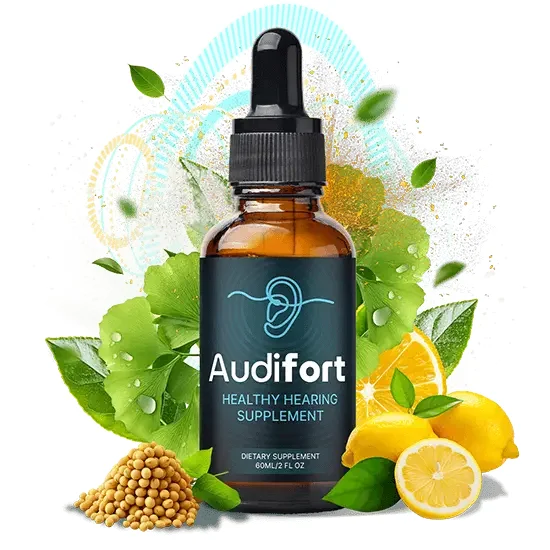
Audifort is a daily liquid supplement from maker Andrew Ross, combining 22 ingredients in a 200 mg proprietary blend plus 0.7 mcg of chromium, in a 60 mL dropper bottle. The recommended dose is one to two droppers (roughly 15 drops) daily, taken sublingually or mixed into water or juice. The liquid sublingual format bypasses some first-pass liver metabolism, which can improve absorption of polyphenols compared with capsules.
The formula leans on three plausible mechanisms: antioxidant support for the cochlea (grape seed extract and green tea EGCG may reduce oxidative stress in the inner ear), circulation (capsicum annuum and green tea are traditionally used to support inner-ear blood flow), and neural calming (GABA). For a full ingredient-by-ingredient breakdown, see our Audifort ingredients analysis.
On the GABA angle specifically: a 2015 study by Sedley et al. in the Journal of Neuroscience found that tinnitus patients had measurably lower GABA concentrations in their auditory cortex than controls (DOI: 10.1523/JNEUROSCI.2695-15.2015), suggesting a role for GABAergic signaling in tinnitus generation. More recently, Watson et al. (2025) in Frontiers in Neurology reported that targeting the GABA-A pathway reduced tinnitus severity (DOI: 10.3389/fneur.2025.1662226). The honest caveat: that trial used an intravenous agent (brexanolone), so whether oral GABA in a supplement reaches the brain at effective levels remains unproven and debated. We dig into this research in our GABA for tinnitus article.
Audifort Pros and Cons
| Pros | Cons |
|---|---|
| 22 ingredients in one formula | Proprietary blend — individual doses not disclosed |
| Liquid sublingual format for absorption | No clinical trial on the finished product |
| 90-day no-questions guarantee (longest in niche, ClickBank-enforced) | Maker suggests 4+ months for best results — beyond the 90-day window |
| USA-made, FDA-registered, GMP-certified, plant-based, non-GMO, stimulant-free | Capsicum + grape seed may interact with blood thinners; L-arginine affects blood pressure |
| One-time payment, no rebills | No single-bottle option; entry price is $158+ |
Pricing: 2 bottles at $79 each ($158 + shipping), 3 bottles at $69 each ($207 + free U.S. shipping + 2 bonuses), or 6 bottles at $49 each ($294 + free U.S. shipping + 2 bonuses). There is no 1-bottle option. The 90-day, no-questions-asked money-back guarantee is enforced by ClickBank, the payment processor — the longest window in this niche.
Who it suits: adults with mild age-related hearing changes or occasional tinnitus who want a broad antioxidant-plus-circulation formula and are comfortable with proprietary blends. Who should avoid it: anyone taking blood thinners, people managing blood sugar without monitoring (gymnema can affect glucose), anyone with blood-pressure concerns (L-arginine), and anyone expecting a cure. For the full safety picture, see Audifort side effects and who should avoid it, and our honest deep dive on Does Audifort Really Work for Tinnitus?
Check current Audifort pricing and try it risk-free for 90 days.
#2 — Quietum Plus: Capsule Format, Ear-Brain Angle
Quietum Plus takes a different route: capsules rather than drops, built around amino acids and an adaptogenic botanical blend. Declared ingredients include zinc, L-tyrosine, L-arginine, B vitamins, mucuna pruriens, maca root, ashwagandha, and dong quai, plus an 802 mg proprietary blend of 12 botanicals (epimedium, tribulus, catuaba). It is sold on its official site and via Digistore24, and the label leans into “Clear Mind, Memory & Focus, Mood Support” as much as hearing — worth knowing if you are buying it for ear health.
Pricing: roughly $49–$79 per bottle depending on quantity, with a 60-day money-back guarantee. It is a credible ear-brain formula at a similar price to Audifort, but the shorter guarantee, the capsule format, and the fact that the hearing-specific claim sits behind a cognitive/mood label keep it at #2 in our ranking. We do not hold an affiliate relationship with Quietum Plus — research it directly.
#3 — SonoVive: Cognition-First, Ginkgo with a Negative Verdict
SonoVive (formulated by Sam Olsen) is a capsule supplement that reads more like a nootropic than a hearing product: Ginkgo biloba, St. John’s Wort, bacopa monnieri, vinpocetine, and huperzine-A, aimed at the hearing–brain connection. There is logic to the angle — auditory processing is a brain function — but the flagship ingredient carries a negative verdict. Ginkgo is the most-studied herbal supplement for tinnitus, and a 2022 Cochrane review of 12 studies (1,915 participants) concluded ginkgo “may have little to no effect compared to placebo” (Cochrane CD013514). The AAO-HNS guideline explicitly recommends against ginkgo, melatonin, and zinc for persistent bothersome tinnitus.
Safety flag: St. John’s Wort is a well-documented herb–drug interaction risk — it speeds up liver enzymes and can reduce the effectiveness of antidepressants, birth control pills, and blood thinners. If you take any prescription medication, talk to your pharmacist before considering this product. Pricing: about $69 per bottle with a 60-day guarantee. It sits at #3 because of the ginkgo negative verdict and the interaction risk, and we are not affiliated with it.
#4 — NeuroQuiet: The Most Generic Option
NeuroQuiet is a liquid-drops formula that frames itself around nerve-and-brain support rather than any hearing-specific mechanism. Its core is B vitamins, magnesium, zinc, and ginkgo — familiar, generally safe ingredients, but the most generic lineup of the four. It runs roughly $59 per bottle with a 60-day guarantee. For affordable, low-risk general nervous-system support it is fine; for targeted hearing or tinnitus support it is the weakest of the group, since it overlaps heavily with a standard multivitamin-plus-ginkgo stack. We are not affiliated with NeuroQuiet.
What Reddit and Quora Users Say
Spend an hour in r/tinnitus on Reddit and you will meet deep, justified skepticism. The most-upvoted answers to “did any supplement actually help?” usually come back “no — but hearing aids, sound therapy, and CBT did.” That sentiment has data behind it: the American Tinnitus Association reports that among 1,788 surveyed tinnitus patients, 23% used supplements, and of those, roughly 70% found them ineffective while about 10% felt worse. On Quora you get the same split — audiologists saying “no evidence,” affiliates saying “life-changing.”
The honest pattern across real threads: the people who say a supplement “worked” tend to describe gradual, modest changes in loudness or coping, not a silence switch — and the people who rage-quit were expecting the silence switch. Set realistic expectations, track results over 60–90 days, and treat any supplement as a support layer on top of audiology care, not a replacement for it.
The Clinical Evidence, Honestly
Here is what the authoritative sources actually say, because a lot of marketing would have you believe otherwise. The NIDCD states plainly that no supplement has been proven effective for tinnitus (nidcd.nih.gov/health/tinnitus). The American Tinnitus Association notes the FDA has approved no supplement for tinnitus, and its survey found most users saw no benefit. The AAO-HNS guideline recommends against ginkgo, melatonin, and zinc for persistent bothersome tinnitus, and the 2022 Cochrane review found ginkgo little better than placebo.
The most scientifically interesting mechanism — GABA — comes closest to a real signal, but it is early. Lower auditory-cortex GABA in tinnitus patients (Sedley et al., 2015) and GABA-A pathway targeting reducing severity (Watson et al., 2025) point to a plausible direction. But oral GABA reaching the brain at therapeutic levels is not established, and neither study tested a consumer supplement. So: the evidence supports careful, modest supplementation as a support layer — and it strongly supports real interventions like hearing aids, sound therapy, and cognitive behavioral therapy, which have actual evidence. See our full review: Audifort review.
Common Concerns & Skepticism
Are these supplements a scam? Not necessarily — but they are oversold. The products we reviewed contain plausible ingredients made in registered facilities, and the guarantees are real. The scam-like part is the marketing that implies they can cure or reverse hearing loss. Judge each one on ingredient transparency, dose disclosure, and guarantee — and never on hype.
Why do some people say they work? Selective reporting, placebo, and real-but-modest effects. People who feel better write reviews; people who feel nothing usually move on. A small percentage of users report genuine, gradual improvement — the survey data says most do not.
Are they safe? Most ingredients are generally recognized as safe at label doses. The real risks are interactions: capsicum and grape seed with blood thinners, L-arginine with blood pressure, gymnema with blood sugar, and St. John’s Wort with a long list of prescription drugs. Check with your pharmacist.
How long should I try one? Most ingredient research runs 8–12 weeks, so 60–90 days is a fair trial. Audifort’s maker suggests 4+ months for best results — honestly, that extends past the refund window, so factor that in. If you notice zero change by day 60, the formula likely is not for your underlying issue.
Is the proprietary blend a red flag? A transparency gap, not necessarily a red flag. It lists the total (200 mg for Audifort) but not per-ingredient doses, so you cannot verify whether each active reaches a clinically relevant level. All four products here use proprietary blends — know what you are buying.
Can a supplement replace my doctor? No. If you have sudden or one-sided hearing loss, see a physician immediately — it can be a medical emergency. Supplements are a support layer, never a diagnosis or treatment. Get a hearing test before spending money on bottles.
Frequently Asked Questions
What is the best hearing supplement in 2026? Based on ingredient density, the 90-day ClickBank-enforced guarantee, liquid absorption, and honest manufacturing standards, Audifort is our top pick at 4.1/5. But no supplement has a published trial showing it reverses hearing loss — the “best” one is the formula that fits your health profile and does not overpromise.
Do hearing supplements actually work for tinnitus? The evidence is weak and inconsistent. Ginkgo failed in a 2022 Cochrane review; zinc and melatonin are advised against by the AAO guideline. GABA has the most promising mechanism research but no finished-product trial. A published survey found about 70% of supplement users reported no effect.
Are hearing supplements FDA-approved? No. Dietary supplements are regulated as food, not drugs. The FDA does not approve them for safety or effectiveness before sale. “FDA-registered facility” means the manufacturing site is registered, not that the product was reviewed or approved.
How long does it take for hearing supplements to work? Ingredient research typically runs 8–12 weeks. A 60- to 90-day trial is reasonable. Audifort’s maker suggests 4+ months for best results, which is worth weighing against the 90-day refund window.
Can I take hearing supplements with my medications? Only your doctor or pharmacist can answer that. Capsicum, grape seed, ginkgo, and St. John’s Wort all have documented interactions. Never start a supplement without checking it against your prescriptions.
Are Audifort ingredients safe for everyone? No. Gymnema can affect blood sugar, L-arginine affects blood pressure, and capsicum plus grape seed may interact with blood thinners. Anyone in those groups should get medical clearance first.
Should I see an audiologist before taking a supplement? Yes. A hearing test tells you whether your issue is hearing loss, earwax, or something needing medical attention — no bottle can do that. Start with a test, then decide whether supportive supplementation makes sense alongside professional care.
Bottom Line: Our Honest Verdict
After comparing the four most popular hearing supplements on the market, here is where we land. Audifort offers the most ingredient-dense formula, the longest and best-enforced guarantee (90 days via ClickBank), liquid absorption, and honest manufacturing standards — which is why it tops our list at 4.1/5. It is not a cure, it hides individual doses behind a proprietary blend, its maker asks for 4+ months, and it has no finished-product trial. Every competitor shares at least one of those problems.
If you are going to try one, use the 90-day window properly: take it consistently, track changes in tinnitus loudness and hearing clarity, and return it if it does not help — that is exactly what the guarantee is for. Try Audifort risk-free for 90 days. But first, book a hearing test — it costs less than a 3-bottle supply and tells you what no supplement can. For more, read our full Audifort review, ingredients guide, side effects guide, GABA research, and does it work.